Why Is the Carrier Bearing Important in Rear-Wheel Drive Vehicles?
In the transmission system of rear-wheel drive vehicles, power needs to pass through a drive shaft with an average length of over 1.5 to 2.5 meters to be transmitted to the rear axle. When the vehicle is cruising at medium to high speeds of 80 to 120 kilometers per hour, the rotation frequency of the drive shaft can reach 100 to 200 Hz. The core function of the intermediate support of the drive shaft is to provide precise radial support points, effectively suppressing the sagging (possibly exceeding 5 millimeters) and elastic deformation of the rotating body caused by its own weight and centrifugal force, and avoiding severe resonance resulting from the deviation of the geometric axis. For instance, in the recall case of some F-150 models by Ford in 2021, the premature wear of the intermediate support bearing was identified as one of the core failure points that caused abnormal vibration and noise of the drive shaft (with a decibel value exceeding 80 dBA), thereby posing a risk of fracture. This structural support ensures the physical stability of the power transmission path.
This component contributes over 30% to the NVH (Noise, Vibration and acoustic roughness) performance of the entire vehicle. Its interior is equipped with A vulcanized rubber bushing containing a special polymer damping layer (typically 0.5-2 mm thick), with a Shore hardness of 60-80 A. Significantly absorb the wideband vibration (energy concentrated in the range of 50-500 Hz) generated by the drive shaft when it is subjected to peak torque (such as 1000 Nm for performance vehicles). Experimental data show that A well-conditioned intermediate support can reduce the vibration acceleration of the carriage floor by more than 40% and lower the noise beside the driver's ears by 3 to 5 dB (A). In the development of AMG high-performance models, Mercedes-Benz particularly emphasizes the tuning of the middle support. Its multi-level hydraulic damping design can reduce the resonance peak of the transmission system by 60%, reaching the quietness standard of luxury sedans. This highlights its role as a key acoustic barrier.
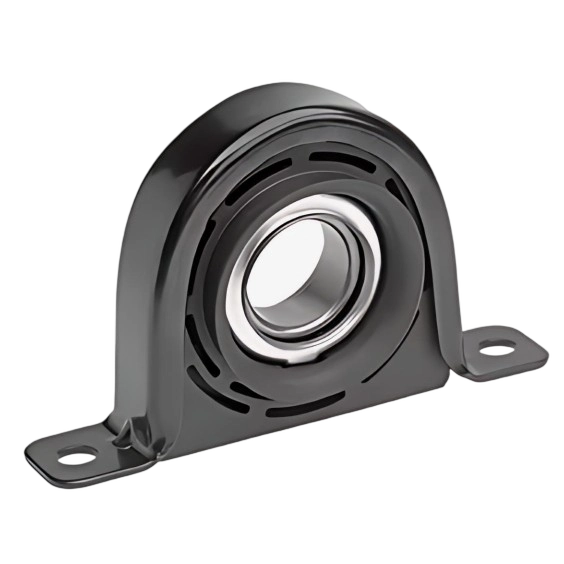 Facing harsh physical and chemical environments, modern intermediate supports employ high-temperature resistant rubber (with a continuous operating temperature range of -40 to +120 degrees Celsius) and reinforced fiber skeletons (aramid or polyester cord layers with a density of 25-40 EPI), combined with long-life greases (such as polyurea greases) A sealed Carrier Bearing structure with a design life of up to 150,000 kilometers or 10 years. The bushing must withstand over 50 million periodic alternating load impact tests, and the rubber fatigue aging life standard requires more than 1,000 hours (at 70°C) of wet heat accelerated aging tests. Industry survey data indicates that on unpaved roads or under high-load conditions, the failure cycle may be shortened to 60% of normal use, leading to a significant increase in operation and maintenance costs. Porsche has applied enhanced intermediate supports to its off-road models. The internal bearing size has increased by 15% and the rubber volume has risen by 20% to withstand extreme impacts during off-roading (with a maximum dynamic load up to eight times that of static loads).
From the perspective of vehicle system integration, the preload force design of the intermediate support (typically within the range of 100-500 N) profoundly influences the critical speed (usually designed above 120% of the engine's maximum speed) and modal distribution of the drive shaft system. Its radial stiffness (typical value is 50-150 N/mm) and damping factor (loss factor is 0.1-0.3) must be optimized in a coordinated manner with the material of the drive shaft (such as carbon fiber, which reduces weight by 50% compared to traditional steel shafts), the engine excitation spectrum and the characteristics of the rear axle main reducer. A study by Toyota shows that improper setting of the stiffness and damping of the intermediate support can increase the torsional vibration amplification rate of the transmission system by three times. This not only exacerbates the vibration and noise problem (the sound level of the interior structure can increase by 5 dB), but also may cause the wear rate of related components such as the oil seal behind the output shaft of the transmission to increase by more than 70%, posing a potential risk of oil leakage. It brings in hundreds of dollars in additional maintenance costs each year.
Timely maintenance or replacement of failed intermediate supports (with a unit cost of approximately $80 to $400 and a labor cost of about 1.5 to 3 hours including labor) is a highly cost-effective preventive measure. Data shows that ignoring the signs of failure (such as abnormal buzzing sounds or increased body shaking at idle) can accelerate the wear of universal joints by 80% and may cause the dynamic balance of the drive shaft to be disrupted (with an unbalance exceeding 50 g-cm) within tens of thousands of kilometers, increasing the risk of power interruption accidents by 300%. Regular vehicle lifting checks (every 10,000 kilometers) by car owners, with a focus on confirming whether the rubber parts of this component have a crack depth exceeding 2mm and whether the axial clearance is greater than 5mm, is a core safety habit to ensure the reliability of the transmission chain and the quality of driving and riding.
Facing harsh physical and chemical environments, modern intermediate supports employ high-temperature resistant rubber (with a continuous operating temperature range of -40 to +120 degrees Celsius) and reinforced fiber skeletons (aramid or polyester cord layers with a density of 25-40 EPI), combined with long-life greases (such as polyurea greases) A sealed Carrier Bearing structure with a design life of up to 150,000 kilometers or 10 years. The bushing must withstand over 50 million periodic alternating load impact tests, and the rubber fatigue aging life standard requires more than 1,000 hours (at 70°C) of wet heat accelerated aging tests. Industry survey data indicates that on unpaved roads or under high-load conditions, the failure cycle may be shortened to 60% of normal use, leading to a significant increase in operation and maintenance costs. Porsche has applied enhanced intermediate supports to its off-road models. The internal bearing size has increased by 15% and the rubber volume has risen by 20% to withstand extreme impacts during off-roading (with a maximum dynamic load up to eight times that of static loads).
From the perspective of vehicle system integration, the preload force design of the intermediate support (typically within the range of 100-500 N) profoundly influences the critical speed (usually designed above 120% of the engine's maximum speed) and modal distribution of the drive shaft system. Its radial stiffness (typical value is 50-150 N/mm) and damping factor (loss factor is 0.1-0.3) must be optimized in a coordinated manner with the material of the drive shaft (such as carbon fiber, which reduces weight by 50% compared to traditional steel shafts), the engine excitation spectrum and the characteristics of the rear axle main reducer. A study by Toyota shows that improper setting of the stiffness and damping of the intermediate support can increase the torsional vibration amplification rate of the transmission system by three times. This not only exacerbates the vibration and noise problem (the sound level of the interior structure can increase by 5 dB), but also may cause the wear rate of related components such as the oil seal behind the output shaft of the transmission to increase by more than 70%, posing a potential risk of oil leakage. It brings in hundreds of dollars in additional maintenance costs each year.
Timely maintenance or replacement of failed intermediate supports (with a unit cost of approximately $80 to $400 and a labor cost of about 1.5 to 3 hours including labor) is a highly cost-effective preventive measure. Data shows that ignoring the signs of failure (such as abnormal buzzing sounds or increased body shaking at idle) can accelerate the wear of universal joints by 80% and may cause the dynamic balance of the drive shaft to be disrupted (with an unbalance exceeding 50 g-cm) within tens of thousands of kilometers, increasing the risk of power interruption accidents by 300%. Regular vehicle lifting checks (every 10,000 kilometers) by car owners, with a focus on confirming whether the rubber parts of this component have a crack depth exceeding 2mm and whether the axial clearance is greater than 5mm, is a core safety habit to ensure the reliability of the transmission chain and the quality of driving and riding.
Facing harsh physical and chemical environments, modern intermediate supports employ high-temperature resistant rubber (with a continuous operating temperature range of -40 to +120 degrees Celsius) and reinforced fiber skeletons (aramid or polyester cord layers with a density of 25-40 EPI), combined with long-life greases (such as polyurea greases) A sealed Carrier Bearing structure with a design life of up to 150,000 kilometers or 10 years. The bushing must withstand over 50 million periodic alternating load impact tests, and the rubber fatigue aging life standard requires more than 1,000 hours (at 70°C) of wet heat accelerated aging tests. Industry survey data indicates that on unpaved roads or under high-load conditions, the failure cycle may be shortened to 60% of normal use, leading to a significant increase in operation and maintenance costs. Porsche has applied enhanced intermediate supports to its off-road models. The internal bearing size has increased by 15% and the rubber volume has risen by 20% to withstand extreme impacts during off-roading (with a maximum dynamic load up to eight times that of static loads).
From the perspective of vehicle system integration, the preload force design of the intermediate support (typically within the range of 100-500 N) profoundly influences the critical speed (usually designed above 120% of the engine's maximum speed) and modal distribution of the drive shaft system. Its radial stiffness (typical value is 50-150 N/mm) and damping factor (loss factor is 0.1-0.3) must be optimized in a coordinated manner with the material of the drive shaft (such as carbon fiber, which reduces weight by 50% compared to traditional steel shafts), the engine excitation spectrum and the characteristics of the rear axle main reducer. A study by Toyota shows that improper setting of the stiffness and damping of the intermediate support can increase the torsional vibration amplification rate of the transmission system by three times. This not only exacerbates the vibration and noise problem (the sound level of the interior structure can increase by 5 dB), but also may cause the wear rate of related components such as the oil seal behind the output shaft of the transmission to increase by more than 70%, posing a potential risk of oil leakage. It brings in hundreds of dollars in additional maintenance costs each year.
Timely maintenance or replacement of failed intermediate supports (with a unit cost of approximately $80 to $400 and a labor cost of about 1.5 to 3 hours including labor) is a highly cost-effective preventive measure. Data shows that ignoring the signs of failure (such as abnormal buzzing sounds or increased body shaking at idle) can accelerate the wear of universal joints by 80% and may cause the dynamic balance of the drive shaft to be disrupted (with an unbalance exceeding 50 g-cm) within tens of thousands of kilometers, increasing the risk of power interruption accidents by 300%. Regular vehicle lifting checks (every 10,000 kilometers) by car owners, with a focus on confirming whether the rubber parts of this component have a crack depth exceeding 2mm and whether the axial clearance is greater than 5mm, is a core safety habit to ensure the reliability of the transmission chain and the quality of driving and riding.