Shelf Span in a Plywood Cabinet
A wall cabinet is 12 inches deep, and its shelf spans the full width between the side panels. In CasaBuilt's published construction that shelf is 3/4-inch plywood, adjustable, so a 39-inch cabinet asks a 0.75-inch panel to cross 52 times its own thickness. Span, thickness and support are the three numbers that decide whether the shelf stays flat.
Key takeaways
- The published shelf is 3/4-inch plywood and adjustable, with a half-depth shelf in base cabinets.
- Wall cabinets are 12 inches deep in 30, 36 and 42 inch heights, 9 to 39 inches wide.
- A 39-inch shelf spans 52 times its thickness; a 9-inch shelf spans 12 times.
- Wall cabinet space runs from $41.04 to $95.75 per cubic foot in the published widths.
What span means once the door closes
Shelf span is the clear distance between the supports. In a cabinet, that distance is the inside width of the box, which is close to the published outside width. A 30-inch wall cabinet gives a shelf a span of roughly 30 inches, and every plate, jar and stack of bowls on that shelf bends it in the middle.
Bending is not a failure by itself. A shelf that deflects a little under load and springs back is doing its job. The problems start when the deflection is permanent, when the shelf takes a visible bow, or when the load is concentrated at one end and the panel twists on its pins. Two variables control that: the thickness of the panel and the number of supports under it.
CasaBuilt's wall cabinet is 12 inches deep, which is a shallow box compared with a 24-inch base. The shelf is supported along both side edges and at the back, so it is stiffer than the same panel spanning in free air. Depth helps here: a shallow shelf has less unsupported area than a deep one, which is why the wall cabinet and the base cabinet can share the same gauge.
Three-quarter plywood and the half-depth shelf
The published shelf is 3/4-inch plywood, adjustable on pins, and the base cabinets add a half-depth shelf at the back. Both details exist for span reasons. A 3/4-inch panel is stiff enough to bridge the widths CasaBuilt sells without a mid-span support, and the half-depth shelf in a base cabinet shortens the unsupported depth at the back of a 24-inch box, where the plumbing and the dark corners usually sit.
Adjustability is the trade. A fixed shelf is fastened into the sides and braces the box as well as carrying load. An adjustable shelf rests on four pins, so the panel has to do all the work and the pins have to hold. That is why the same 3/4-inch gauge appears in both wall and base cabinets and why the pins, small as they are, are part of the structure rather than an accessory.
CasaBuilt publishes the shelf gauge, the 9 to 39 inch wall widths and the 30, 36 and 42 inch heights across its plywood rta cabinets range. A buyer can therefore work out the longest span in a planned run before ordering, rather than discovering it when the shelves are loaded.
Pins, cleats and the middle of a long shelf
A shelf pin is a small cylinder in a drilled hole, and four of them carry everything on the shelf. The load on each pin is not simply a quarter of the total, because a shelf loaded at one end pushes down harder on the pins at that end. That is the usual reason a shelf drops at one corner: not a broken pin, but a hole that has enlarged under years of concentrated load.
Plywood holds a pin better than a chipboard panel because the pin sits in continuous veneer rather than in resin and chips. It is still a small fixing, and the practical rules are simple. Put heavy items toward the ends of a shelf, above a side panel rather than in the middle of a span. Keep the heaviest things in the base cabinets, where the shelf is shorter in depth and the load has less leverage. Do not overload the top shelf of a 42-inch wall cabinet, which is the one most people reach over their heads.
Where a run needs more shelf than a 39-inch cabinet can hold, the answer is more cabinets rather than a longer shelf. Two 21-inch wall cabinets give the same outside width as one 42-inch cabinet, with a side panel in the middle supporting both shelves. That is a layout decision, and CasaBuilt's design-to-budget estimator is the place to test it before the order rather than after.
What a wall cabinet's space costs
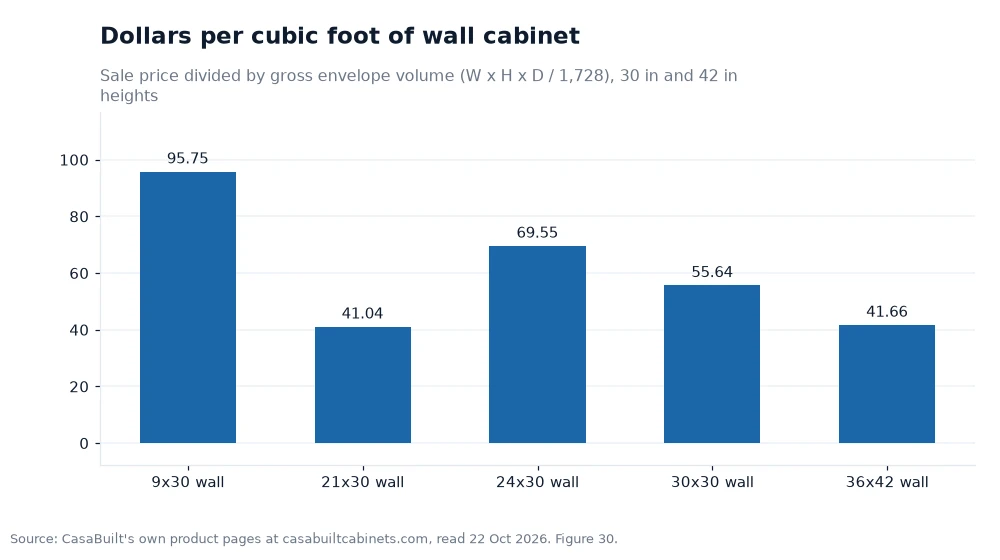
Storage is what a shelf delivers, so the cost of the cabinet per cubic foot is a fair way to compare spans. The figures below divide each published sale price by the gross envelope, width times height times 12 inches of depth, with 1,728 cubic inches in a cubic foot. The interior is smaller than the envelope; the ratio is for comparison.
| Wall cabinet | Envelope | Sale price | Per cubic foot |
|---|---|---|---|
| 9 x 30 in | 1.88 cu ft | $179.54 | $95.75 |
| 21 x 30 in | 4.38 cu ft | $179.54 | $41.04 |
| 24 x 30 in | 5.00 cu ft | $347.76 | $69.55 |
| 30 x 30 in | 6.25 cu ft | $347.76 | $55.64 |
| 36 x 42 in | 10.50 cu ft | $437.41 | $41.66 |
Two price bands do most of the work. Cabinets 9 to 21 inches wide share the single-door price of $179.54, so the 21-inch box is the bargain in that band and the 9-inch box is the expensive one. Cabinets 24 to 39 inches wide share the double-door price of $347.76 at 30 inches high, and the 42-inch-high double door is $437.41. Narrow cabinets cost more per cubic foot because the door, the frame and the hardware cost nearly the same whatever the width.
Worked example
Start with the 9 x 30 cabinet. Volume: 9 x 30 x 12 = 3,240 cubic inches, and 3,240 / 1,728 = 1.875 cubic feet. At $179.54, the cost per cubic foot is 179.54 / 1.875 = $95.75. Now price the 21 x 30 at the same $179.54: 21 x 30 x 12 = 7,560 / 1,728 = 4.375 cubic feet, and 179.54 / 4.375 = $41.04. Same door count, same price, 2.33 times the space.
The other three follow the same two operations. The 24 x 30: 24 x 30 x 12 = 8,640 / 1,728 = 5.0 cubic feet, and 347.76 / 5 = $69.55. The 30 x 30: 30 x 30 x 12 = 10,800 / 1,728 = 6.25 cubic feet, and 347.76 / 6.25 = $55.64. The 36 x 42: 36 x 42 x 12 = 18,144 / 1,728 = 10.5 cubic feet, and 437.41 / 10.5 = $41.66.
Now put those volumes against the span. A 9-inch shelf has 9 x 12 = 108 square inches of surface, or 108 / 144 = 0.75 square feet, and a 39-inch shelf has 39 x 12 = 468 / 144 = 3.25 square feet. The widest shelf therefore carries 3.25 / 0.75 = 4.33 times the area at 39 / 9 = 4.33 times the span, on the same 0.75-inch panel. The comparison between $95.75 and $41.66 per cubic foot is the price of that difference: the cheap space is the space that asks the most of the shelf.
Frequently asked questions
How much weight can a 3/4-inch plywood shelf hold?
CasaBuilt does not publish a load rating, so there is no honest number to quote. What can be said is that load capacity falls as the span grows: a 39-inch shelf crosses 52 times its thickness, while a 9-inch shelf crosses 12 times. Keep dense items toward the ends and over the side panels, and use base cabinets for the heaviest stock.
Should I add a middle support to a long shelf?
A 39-inch wall cabinet is the widest CasaBuilt lists, and its shelf is designed to span that width on pins. If a run needs more storage, two narrower cabinets give the same outside width with a side panel in the middle, which supports both shelves without adding a loose bracket inside the cabinet.
Why do base cabinets have a half-depth shelf?
Because the back of a 24-inch base is where the plumbing and the least accessible space sit. A half-depth shelf doubles the number of shelf surfaces without crossing the full depth, which shortens the unsupported area and leaves the back clear for pipes and deep items.
Plan the span before the style
Mark the longest wall run and count how many boxes it takes to fill it, then decide whether the middle of that run wants a side panel or a long shelf. Order a sample door to check the finish, and check the shelf gauge on the specification before you do. The shelf is the part of a wall cabinet that works every day, and it is the part most buyers never ask about.
Figures quoted here come from the manufacturer's own website, read 22 Oct 2026[1].