Reading Energy Efficiency Claims in Brewing Equipment
Almost every equipment brochure promises energy saving, and almost none of them say what was measured. The useful question is not whether the plant is efficient but where the heat goes: into raising mash water, into the boil, into the kettle's jacket losses, or out of the door as steam that nobody captured. HGMC publishes its advantages in terms of design detail — steam system, jackets, headspace, automatic temperature control — and detail is something you can check on a drawing.

Key takeaways
- Ask what was measured, at what batch size and against which baseline before accepting any efficiency figure.
- Heating a 1,000 litre batch from cold mash water to a finished boil is roughly 380 MJ of useful heat before losses.
- Published design points to verify: a well-designed steam system, jackets on both body and cone, and headspace calculated separately.
- Control level matters to running cost, because automatic temperature control prevents the over-heating and over-chilling that waste energy.
Separate the claim from the measurement
An efficiency claim is only meaningful with three things attached: the batch size, the measurement point and the baseline. "Lower energy consumption" against an unstated alternative tells you nothing. Ask for the heat input per brew in kilowatt hours or megajoules, the evaporation rate the kettle is designed for, and the temperature the cooling water is assumed to arrive at, because all three move the number.
Published advantages in this range are stated in design terms rather than as a single percentage: energy saving with higher brewing efficiency and lower material consumption, fully automatic control of mash, wort and water flow with automatic temperature control, a well-designed steam system, piping designed to avoid wort aeration, jackets on both the body and the cone, and a larger headspace with the cover headspace volume calculated separately. Each of those is a specification you can point at on a drawing, and a buyer evaluating a hgmc brewing proposal should ask for them by name rather than accepting a general statement about efficiency.
Steam systems and where the heat goes
If the plant runs on steam, the boiler, the pipe insulation and the condensate return are where the money leaks. A well-designed steam system keeps the runs short, insulates what it can and returns condensate rather than dumping hot water down the drain. Direct-fire and electric heating avoid the boiler but put the demand on gas supply or electrical capacity, and each option changes how the kettle behaves through a brew.
The kettle's jacket design decides how much heat actually reaches the wort. Published vessels carry specially designed jackets on both the body and the cone, which gives a larger heated surface and a more even boil, so the element or the steam coil spends less time running flat out. Check whether the jacket has its own drain, because a jacket that cannot be emptied properly loses heat through trapped water and is harder to clean.
Jackets, headspace and hot liquor recovery
Headspace is the quiet one. A vessel with a larger headspace, with the cover headspace volume calculated separately rather than estimated, boils more calmly and foams less, which reduces boil-overs and the cleaning and product loss that come with them. It also means the boil can run at the intended rate instead of being throttled back to keep wort off the ceiling.
Hot liquor recovery is the other easy win. Water leaving a plate heat exchanger after knocking out a batch is still warm, and a hot water tank plus a return loop lets it preheat the next brew's mash water. The published example bill of materials for a 10 BBL system includes a 20 BBL hot water tank, so the vessel is already part of the standard plant; whether the pipework returns heat to it is a design choice made at the drawing stage.
| Published point | What to ask for | Why it matters |
|---|---|---|
| Energy saving, higher brewing efficiency | Heat input per brew, batch size and baseline | Turns a slogan into a number you can compare |
| Well-designed steam system | Run lengths, insulation schedule, condensate return | Steam losses are the largest avoidable cost |
| Jackets on body and cone | Jacket drawing, drains, glycol flow rate | Even heating and cooling without throttling the boil |
| Headspace volume calculated separately | The fill level and headspace figure on the drawing | Fewer boil-overs, less cleaning, less product lost |
| Automatic temperature control | Control level and the records the panel prints | Repeatable batches without over-heating or over-chilling |
Worked example: the heat in one 1,000 litre batch
Example, with assumptions stated. Take 1,000 litres of mash water, treated as 1,000 kilograms of water, heated from 15 °C to 65 °C. That is a 50 K rise, and at a specific heat of about 4.0 kJ per kilogram per kelvin the heat required is 1,000 × 4.0 × 50 = 200,000 kJ, or 200 MJ. Then the boil: assume 8 per cent evaporation from a 1,000 litre batch, which is 80 litres of water, and a latent heat of about 2,257 kJ per kilogram, giving 80 × 2,257 = 180,560 kJ, or about 181 MJ. The useful heat for the batch is 200 + 181 = 381 MJ.
Assume the plant delivers heat at 85 per cent efficiency, so the energy that has to be bought is 381 ÷ 0.85 ≈ 448 MJ per batch. Converted at 3.6 MJ per kilowatt hour that is 448 ÷ 3.6 ≈ 124 kWh. Twelve brews a month is 124 × 12 ≈ 1,490 kWh a month, and about 1,490 × 12 ≈ 17,900 kWh a year before cleaning, hot liquor and cooling. Those figures ignore heat recovery, so a plant that returns warm water from the exchanger will use less; the arithmetic is here to show which questions to ask, not to promise a running cost.
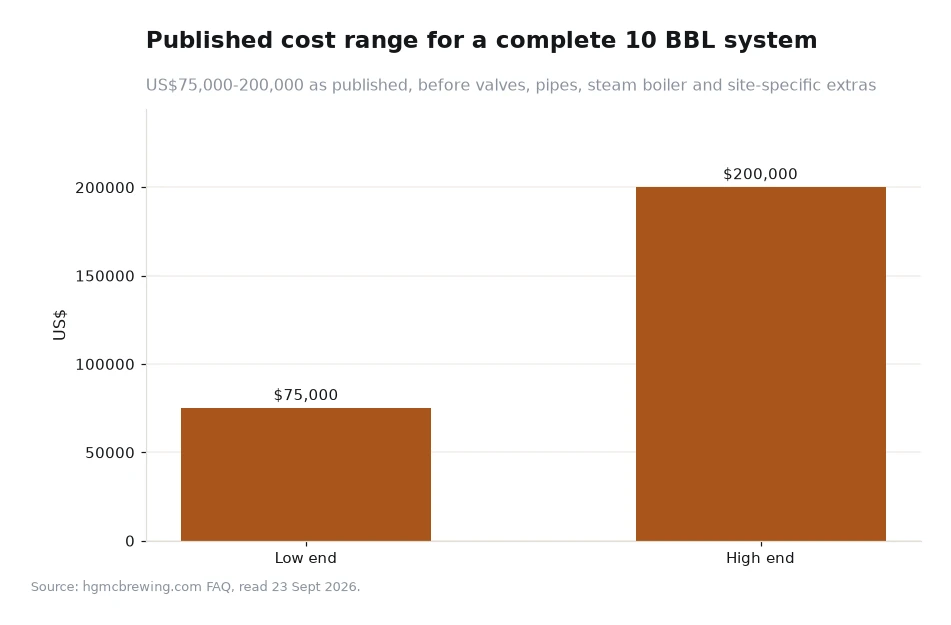
One published number makes the point about scope. The example range for a complete 10 BBL system is US$75,000–200,000, and the same page notes that valves, pipes, a steam boiler and other requirements change the figure — the boiler is called out separately precisely because it is a site-specific item that decides much of the running cost.
Frequently asked questions
How can I check an energy efficiency claim for brewing equipment?
Ask for the heat input per brew, the batch size it was measured at and the baseline it is compared with. A figure without those three details cannot be compared with your own plant's numbers.
Does a larger headspace or better jacket really reduce running costs?
Both affect it. Jackets on the body and cone heat and cool more evenly, and headspace volume calculated separately reduces boil-overs, which saves the cleaning and product loss that follow a boil-over.
Turning claims into a checklist
Take the specification you are offered and mark each energy-related statement against the drawing it refers to. Where a claim cannot be traced to a vessel dimension, a pipe route, an insulation schedule or a control function, it is marketing rather than engineering, and it should not influence the purchase decision.
For comparison, the published grouping on the brewery-system pages shows what changes with capacity, the beer brewing equipment section describes the vessel details behind the claims, and the brewhouse equipment pages cover vessel configuration and heating. Buyers who want the detail in writing can start from the main site and ask for a specification with the measurements included.
Published figures and design points come from the manufacturer's own website, read 23 Sept 2026: the steam system, jacket and headspace design notes, automatic mash, wort and water flow control, the 2 to 5-vessel configurations with electric, steam and gas heating, the example cost range of US$75,000–200,000 for a complete 10 BBL system, the 90–150 day deposit-to-door window, and the 6-year warranty on tank accessories and electronic components against manufacturing defects from the factory, used within scope. The heat and consumption arithmetic is this article's own labelled example.[1]