A Closer Look at Reviewing carton and product checks before shipment
Product and carton checks answer different questions but should share one order baseline. A clear lot definition, sampling method, packing criteria, and evidence trail make findings useful for the shipment release decision.
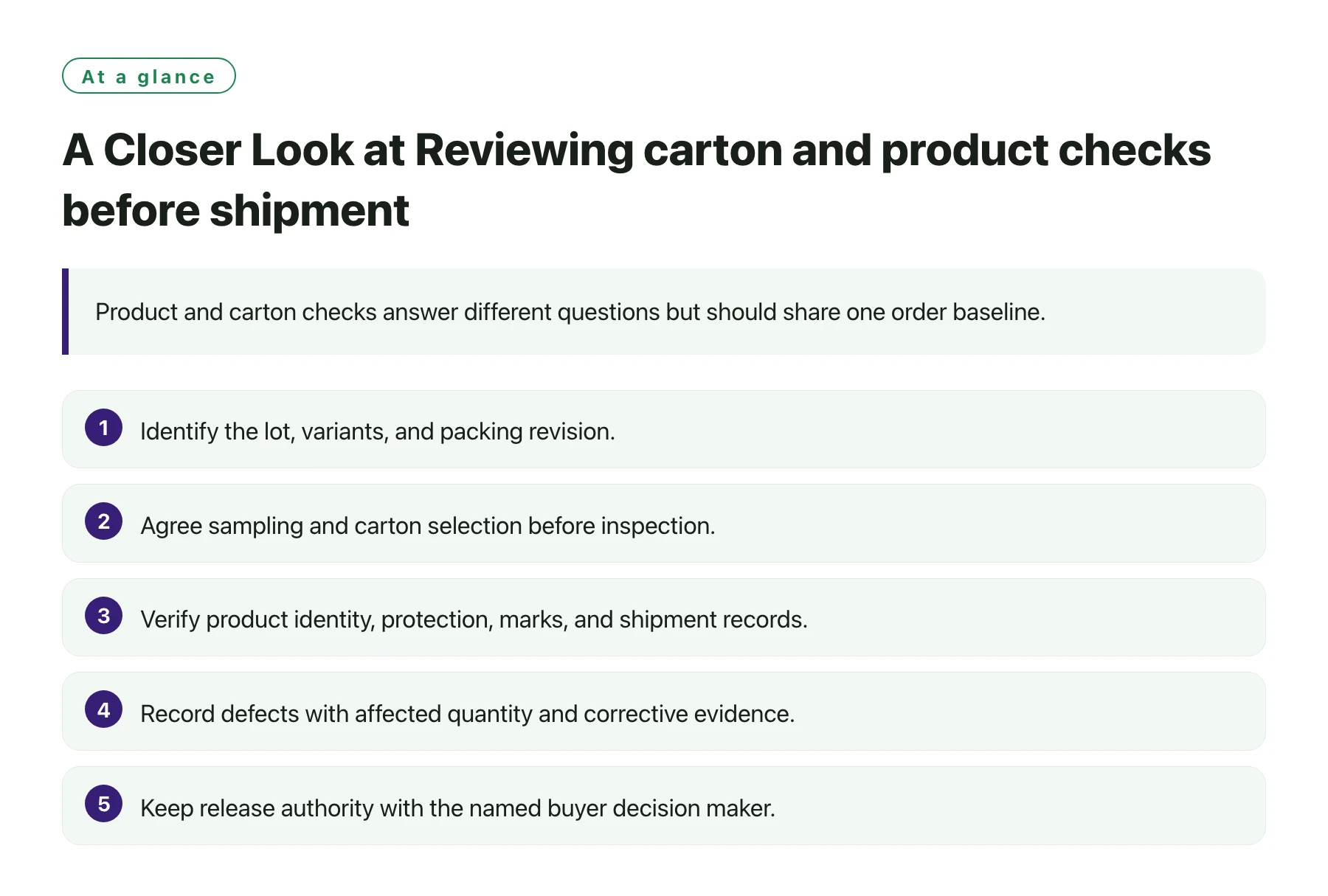
Key takeaways
- Identify the lot, variants, and packing revision.
- Agree sampling and carton selection before inspection.
- Verify product identity, protection, marks, and shipment records.
- Record defects with affected quantity and corrective evidence.
- Keep release authority with the named buyer decision maker.
A product can pass a visual check while the carton or identifier is wrong. Review the packaged shipment against both technical and logistics requirements.
1. Keep product and carton checks connected
A pre-shipment review should connect finished-product results to the cartons that will travel. First identify the order, models, variants, lot boundaries, total quantities, approved sample, and packing revision. Ask the factory to separate held or reworked goods from finished stock so the inspected population is clear.
Prepare a matrix with product criteria and packing criteria side by side. Include the purchase-order requirement, check method, sample or coverage, acceptable limit, evidence record, and defect class. This avoids an inspection that checks visible product quality but misses the carton labels, protection, or configuration needed at destination.
2. Agree lot definition and sampling before the visit
Define what counts as one lot: product model, production run, shift, component set, or another traceable unit. Agree how samples are selected, who selects them, which cartons are opened, and how replacements are handled. A sample chosen by the factory may not represent the completed shipment if it comes from a special display batch.
ISO 2859-1 describes sampling procedures indexed by acceptance quality limit for inspection by attributes. Select any applicable plan with a qualified quality owner and state it in the buyer-supplier instructions; the standard does not create a universal acceptance promise for every product or order. [1]
3. Check carton identity and marking
Compare carton markings with the approved artwork and shipping instructions: buyer or project reference, model, quantity, variant, carton sequence, handling symbols, destination, and barcode where applicable. Check legibility, placement, color, and whether marks remain visible after strapping or pallet wrap.
For mixed orders, verify that labels distinguish variants and that carton numbers reconcile to the packing list. Record examples and exceptions. If local market labels or languages apply, route content to the qualified compliance owner and confirm the factory is using the approved version rather than a previous export template.
4. Assess packing protection and construction
Inspect carton strength, internal dividers, foam or other protection, bags, corner guards, moisture barriers, and pallet arrangement against the agreed transit and handling conditions. Examine whether the product can move or abrade inside the package and whether accessories can puncture or scratch neighboring items.
Open representative cartons and document the assembly order and packing method. Compare the observed materials with the approved sample and specification. If packaging is compressed, wet, crushed, or incomplete, record the extent and ask the buyer to decide whether repacking, reinspection, or another protective measure is needed.
5. Verify product quantity and configuration
Count units and major accessories against the order and packing list. Confirm model, size, finish, voltage or other variants, serial or lot marks, manuals, fasteners, spare parts, and included options. Trace at least one representative item from carton to product identity and back to its label.
Check that the inspected product configuration matches the approved sample, drawings, and quote. For a functional criterion, state the test condition, sample size, method, and pass limit. A visual examination does not confirm hidden composition, long-term durability, or every unit in a lot; identify when a separate test or document review is required.
6. Decide which tests occur before packing
Plan inspection sequence so product checks happen before cartons are sealed, while packing checks happen on finished cartons. If cartons were sealed earlier, agree how they will be selected and reopened and how they will be resealed. Record any product or packaging condition that cannot be observed without destructive opening.
Where measurements or function tests are needed, specify tools, settings, units, and acceptance values. If a test fails, preserve the original result and identify affected lot and cartons. Avoid replacing failed samples without permission or treating a rework promise as evidence that the shipment now complies.
7. Record defects and containment actions
For each finding, record the criterion, observed condition, quantity affected, carton or lot identity, photograph or measurement, defect class, and recommended disposition. Distinguish isolated damage from a recurring pattern and state how many items were examined. Keep the original findings even if correction begins during the visit.
Agree how the factory segregates nonconforming goods, identifies repacked cartons, and records repairs or replacements. A reinspection should define whether it covers corrected items, a new sample, or the full affected lot. The authorized buyer should decide whether a concession or shipment release is acceptable.
8. Reconcile cartons to shipment records
Compare the final carton count, pallet count, gross and net weights where required, dimensions, packing list, and shipment marks. Ask who records container loading, seal number, and any special handling. Identify documents prepared by the factory versus the buyer’s freight provider and clarify the handoff deadline.
If the shipment will be split, map carton ranges to each destination or booking. Resolve mismatches before dispatch so receiving teams are not left with quantities or identifiers that cannot be reconciled. Keep dated records and approved exceptions in the same order file as the inspection report.
9. Use findings in a release decision
A report should state product identity, lot definition, sampling plan, quantity status, test methods, carton coverage, results, limitations, and inspector. Check that conclusions match the evidence. If cartons were not opened or a critical check was omitted, treat the gap as unresolved rather than assuming a pass.
Define the consequence of pass, fail, conditional pass, and incomplete inspection before the visit. Name who can authorize rework, partial shipment, or a concession. Link release conditions to the purchase agreement and make sure finance and logistics teams receive the same decision record.
10. Improve the next order from the evidence
Track recurring product and packaging defects by model, supplier, and process step. Use the findings to refine carton design, work instructions, sample plan, labels, or training. Verify that a corrective action changes routine production rather than only the small set of goods seen by the inspector.
Teams arranging JS Sourcing pre-shipment inspections can use one brief to coordinate product checks, carton examination, reporting, and release decisions. Confirm the inspection scope and sampling criteria in writing, then preserve product and packing evidence with the final shipment file.
Sources
Frequently asked questions
Should cartons be opened during a pre-shipment check?
Open representative cartons when the agreed scope includes inner packing or product-to-carton traceability; define selection and resealing controls beforehand.
Do carton labels need to match the packing list exactly?
They should follow the approved marking scheme and allow the shipment quantity and variants to be reconciled without ambiguity.
Does a sample inspection prove every carton is correct?
No. The report describes the defined sample and checks; lot-wide conclusions depend on the agreed plan and its limitations.
What should happen after a packing defect is found?
Record the affected cartons, agree containment and correction, then define reinspection evidence and an authorized release decision.